
Governance-First Cloud Cost Control
As cloud environments expand across providers, services and regions, the financial structures used to manage them often struggle to keep up.
Most organisations begin their cloud journey with a simple objective: understand what they are spending and reduce waste. Visibility and optimisation become the first priorities, creating early efficiency.
For a time, this works well.
But as cloud becomes a material operating expense and environments expand across multiple platforms, something begins to change. Costs may still be optimised, yet financial stability becomes harder to maintain.
Understanding why requires looking at how cloud cost management typically evolves.
The Evolution of Cloud Cost Maturity
Cloud cost management usually develops in stages as environments grow more complex.
Organisations typically begin by gaining visibility into spend and then focus on optimisation efforts such as rightsizing workloads or reducing unused resources. These steps create savings and improve efficiency.
For a time, that approach works well.
However, as enterprise cloud estates expand across providers, SaaS platforms and emerging consumption models such as AI services, the financial landscape becomes more complex.
Optimisation efforts may still be active, yet costs can begin to feel increasingly unstable.
This is often the moment when organisations realise that efficiency alone does not guarantee financial control. If optimisation is already taking place, why does cloud spend still feel unpredictable?
The progression below outlines how cloud cost management typically matures as environments become more complex
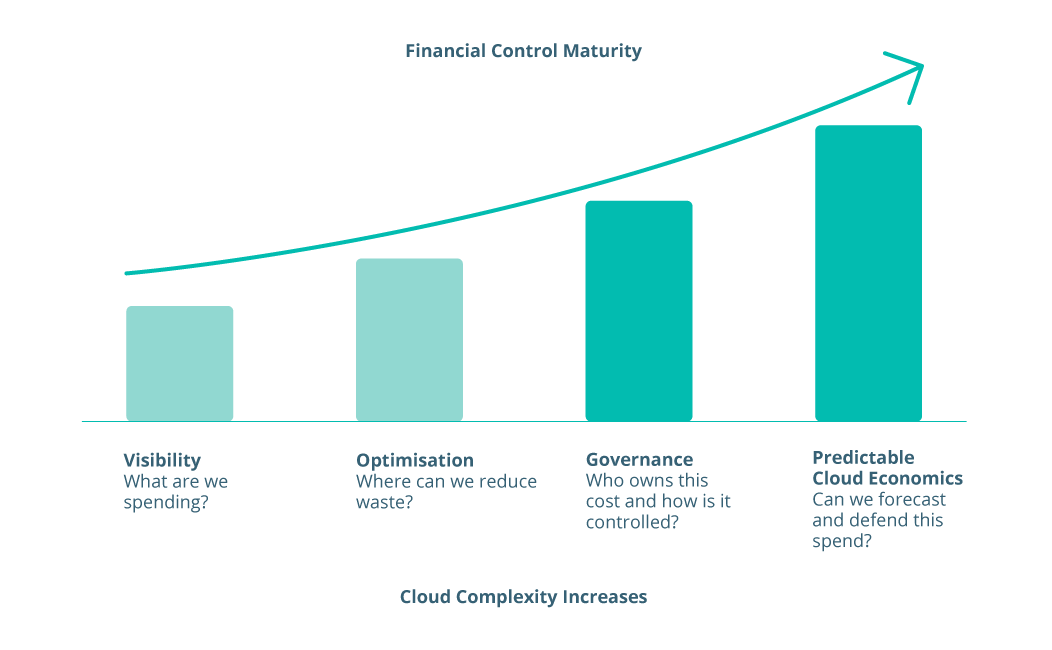
Most organisations operate comfortably in the early stages of visibility and optimisation. As environments scale, however, financial maturity needs to progress beyond efficiency alone.
The challenge usually begins when cloud environments expand beyond a single platform.
The Multi-Cloud Fragmentation Map
As cloud estates grow, they rarely remain within one provider.
Infrastructure may span multiple cloud platforms. SaaS services introduce additional spending streams. AI workloads bring new usage-based pricing models.
Financial data flows through several operational and financial systems before reaching decision-makers.
Each system works effectively on its own.
The difficulty appears when financial information from all of these systems needs to be combined into a single, reliable view of cloud spend.
The structure below captures how financial data begins to fragment as cloud environments expand across providers, operational tooling and financial systems.
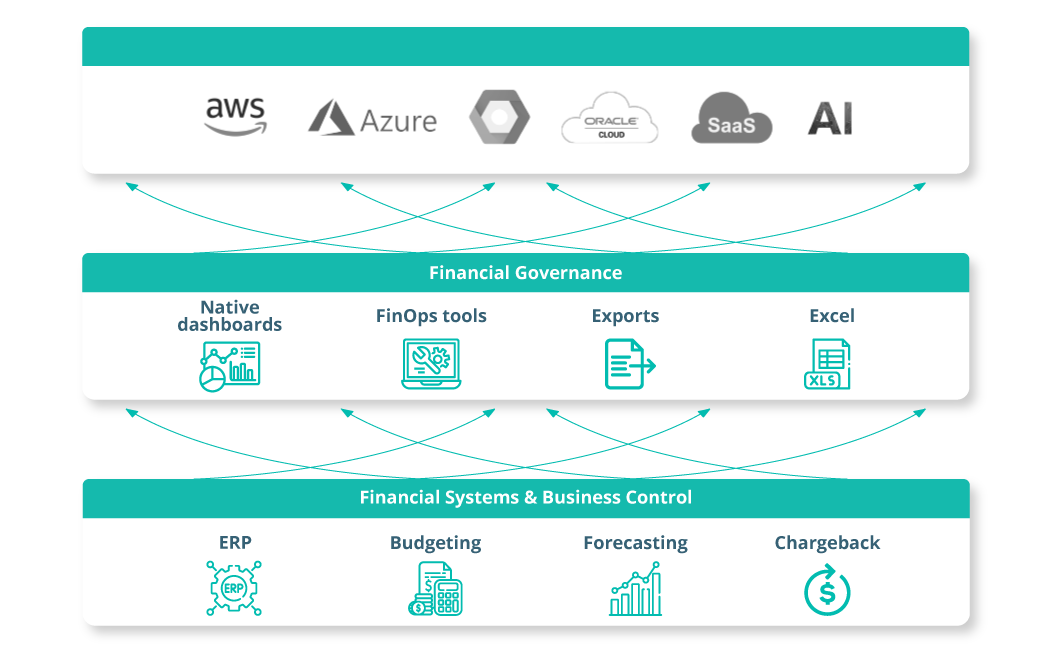
Over time, the technical architecture designed to run workloads grows faster than the financial architecture designed to govern it.
The result is fragmentation.
Fragmentation rarely creates overspend immediately. Instead, it introduces friction. Reporting becomes more effort-heavy. Allocation models become harder to maintain. Forecasting requires increasing explanation.
At first this friction is manageable. But as complexity increases, the effort required to explain the numbers begins to affect confidence in them.
This is where financial tension begins to escalate.
The Pain Escalation Model
Financial instability rarely begins with a dramatic failure.
More often, it begins with increasing effort required to explain the numbers. Reporting takes longer to compile. Finance and IT teams may interpret the same data slightly differently. Forecasts require more explanation than before.
At this stage the environment still functions, but it becomes increasingly fragile. More time is spent validating numbers than using them to make decisions.
The progression below illustrates how financial tension typically escalates as fragmentation persists.
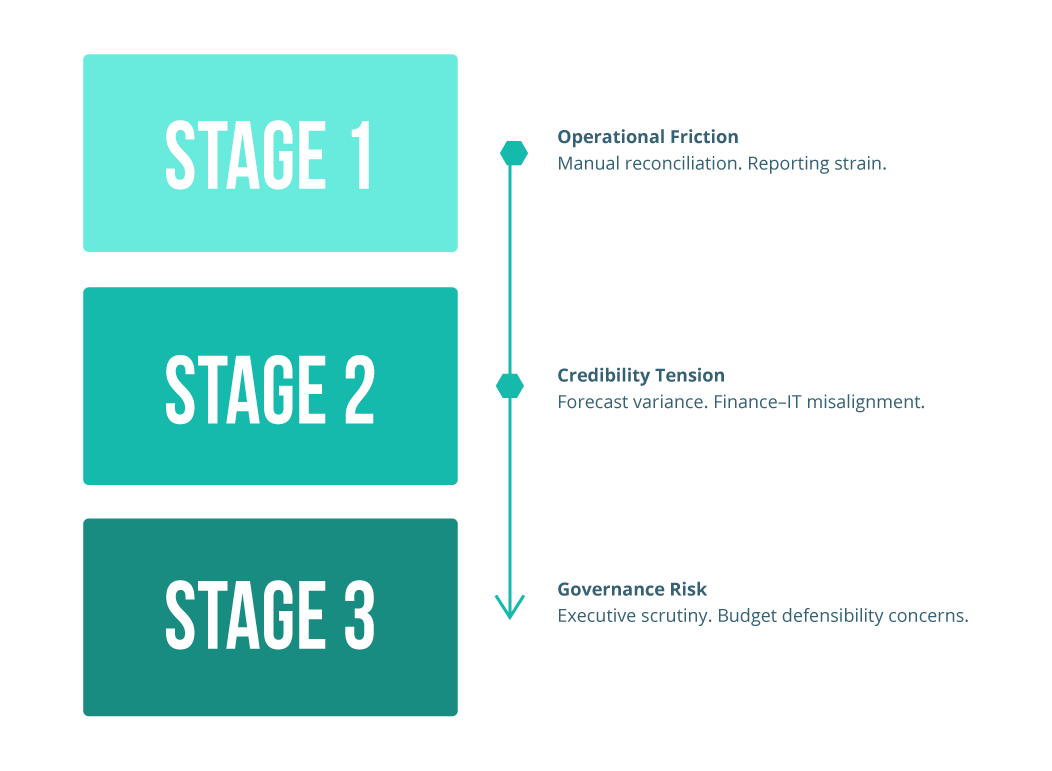
As cloud spend grows, this tension eventually reaches leadership levels. Executives begin asking not only how much is being spent, but why costs appear difficult to predict.
At this point cloud is no longer viewed purely as a technology expense. It becomes a financial governance issue.
Many organisations respond by pursuing additional optimisation tools or dashboards. However, the underlying problem is rarely insufficient optimisation.
It is the absence of structural financial control.
The Financial Governance Layer
When fragmentation reaches this stage, adding more tools rarely resolves the issue.
The challenge is not visibility alone. Most organisations already have access to significant volumes of cost data.
The real challenge is alignment.
A financial governance layer introduces that alignment by sitting across the cloud environment and establishing a consistent financial structure.
The model below highlights how governance restores structural financial alignment across providers, operational tooling and financial systems.
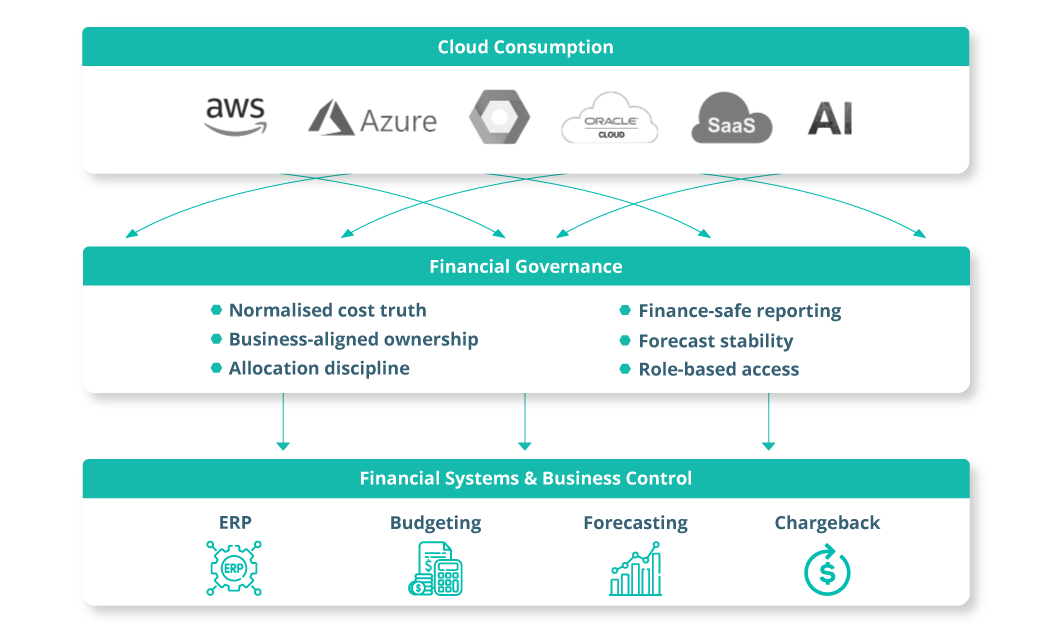
Rather than replacing native cloud tools or existing optimisation practices, governance connects them through a unified financial framework. Cost data becomes normalised across providers. Allocation models align with business ownership. Financial reporting becomes consistent across technology and finance teams.
As this governance structure matures, cloud cost management begins to resemble a form of financial infrastructure within the organisation. Cloud consumption, allocation and financial reporting become part of a structured financial system rather than a collection of disconnected transactions.
Once this structure is in place, cloud cost stops behaving like a series of isolated expenses and begins functioning as a governed financial environment.
With that foundation established, the benefits begin to compound.
The Value Ladder
Financial governance does not deliver value instantly. Its impact builds over time as structural clarity improves.
The first benefit is unified financial visibility across the cloud estate. Data that was previously fragmented across systems becomes consistent and easier to interpret.
Governance then introduces clear ownership and allocation discipline, allowing business units to understand and manage the financial impact of their cloud consumption.
The progression below illustrates how financial value compounds as governance maturity increases.
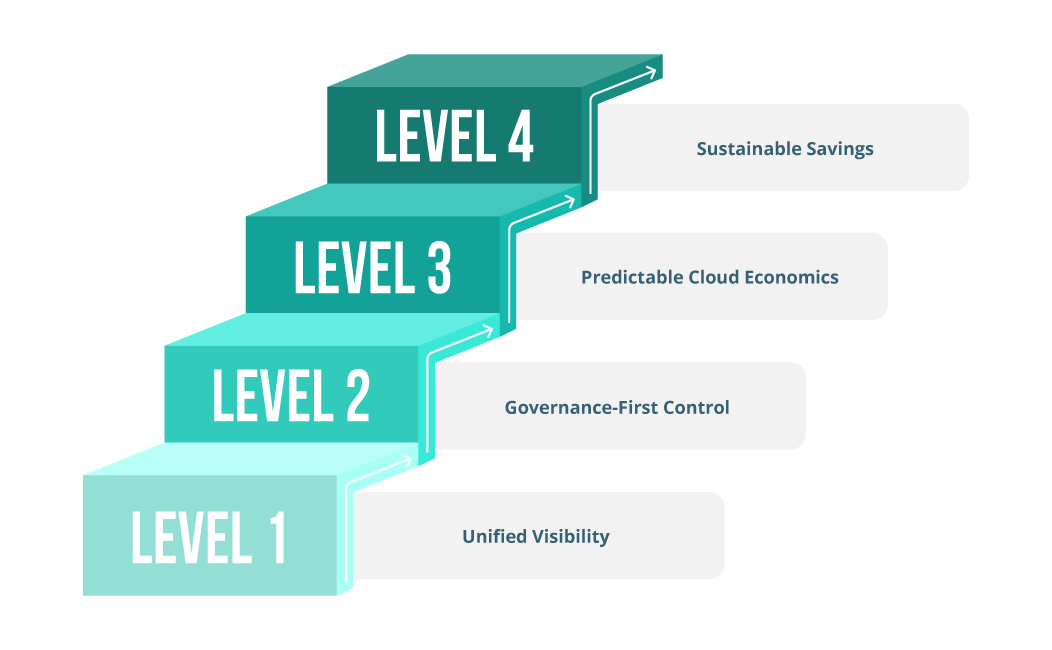
As these structures mature, forecasting becomes more reliable and cloud spend becomes easier to defend at an executive level.
Only at this stage do optimisation efforts become truly sustainable. Efficiency improvements persist because they are supported by a stable financial framework.
Cloud cost management often begins with the pursuit of savings. Over time, organisations discover that lasting savings depend on something more foundational.
Visibility enables optimisation.
Governance enables financial control.
Control creates stability.
And stability is what ultimately makes cloud economics predictable.
Bottom line
Cloud infrastructure is evolving faster than the financial systems designed to govern it.
Multi-cloud environments are rarely the result of a deliberate strategy. They emerge naturally as organisations adopt specialised cloud services across providers, SaaS platforms and AI workloads.
Once that complexity exists, financial governance is no longer optional. It becomes necessary.
Organisations that establish financial structure across their cloud environments gain something far more valuable than short-term optimisation.
They gain predictable cloud economics.
Explore how OneView Cloud Cost Management restores financial clarity across complex cloud environments →